“When I find myself in times of trouble, Mother Mary comes to me, speaking words of wisdom, let it be.” – Paul McCartney
While it’s doubtful Paul had a Marian apparition, nor any Beatle – and to be clear, this lyric is inspired by his own mother – it seems right to open this piece with a beautiful, familiar melody in mind. Music has the spiritual ability to soften our hearts, calm our minds, and in this case, enable us to receive a thesis based on biblical exegesis (and not to worry, we surely won’t contrive theology from this lyric).
With the season of Advent upon us, as Christians around the world prepare their homes for Christmas, it may prove helpful to meditate on certain mysteries from this “greatest story ever told.” One beloved but often misunderstood individual in the Nativity story is Mary, the Mother of Christ. Regardless of where Christians choose to land in their feelings towards her, there are profound truths that we need to investigate with open hearts.
An outsider of the Church might be surprised to find that we (Christians) have different perceptions on the Mother of our Savior; the woman predestined by God the Father to be the mother of the incarnate “Word made flesh.” A student of history can see this is no doubt due to “excesses” practiced at certain times in our church history. However, what is equally true is that we have since dramatically “thrown out the baby with the bath water,” or rather, “severed the mother from the baby.” So as Christians put out their Nativity scenes, with a statue (“graven image”) of Mary, it seems right to pursue an understanding of who this woman is.

To be fundamentally clear from the start, everything said, written – and dare we say, exalted – of Christ’s mother is meant to be deflected to God the Creator. This invokes the image of an Artist and their masterpiece. When we comment on the beauty of an Artist’s work, we are not taking glory away from the Artist – on the contrary, we are glorifying his creative process! His creation! His purposes! Is it possible to “Rejoice” in what God has done for Mary, as she does in her Magnificat found in the Infancy Narrative in the Gospel of Luke?
When a Spirit-filled Elizabeth exalts her cousin – “Blessed are you among women, and blessed is the fruit of your womb!” – Mary’s response proves the intention of her heart; namely, to glorify her Son:
“My soul magnifies the Lord, and my spirit rejoices in God my Savior, for he has regarded the low estate of his handmaiden. For behold, henceforth all generations will call me blessed; for he who is mighty has done great things for me, and holy is his name.” (Luke 1:46-49)
If Mary is elevated above Christ, it is us at fault, and not Mary – as her heart is to stir affection for her Son, our Savior. Just as a masterpiece stirs our affection for the Artist. She is forever a “handmaiden of the Lord” who “all generations will call blessed” – although many haven’t for centuries. To drive the point home further, Mary’s very being magnifies her Son. As Archbishop Fulton J. Sheen put it:
“God who made the sun, also made the moon. The moon does not take away from the brilliance of the sun. All its light is reflected from the sun. The Blessed Mother reflects her Divine Son; without Him, she is nothing. With Him, she is the Mother of men.”
Returning to the season of Advent, the first of these mysteries to explore is the Annunciation, found in beginning of Luke’s Gospel, seemingly given from the perspective of Mary herself. The narrative opens, with God’s heavenly messenger, Gabriel, addressing Mary – although not by name – with what we’ve translated as “Hail” (Ave), “Rejoice” or “Greetings;” which indicates a sort of royal greeting, a joyful invitation, a certain “wooing” – and it guides us to the Father’s affection for this woman. Then follows the unique Greek word kecharitomene, which was translated “full of grace” (gratia plena) for centuries, and in modern history translated “thou that art highly favored,” or “O favored one.” The implications Luke seems to want to convey in this single word require thoughtful research. For the sake of the piece – as one can find specifics nowadays, the implication is that Mary had been endowed with grace for this divine task. This word implies that she was predestined; graced – and yet still called. From this perspective, it seems appropriate that the angel proclaims this word to Mary as if it’s her new name – in the same way God changed Abram’s & Jacob’s names, and Jesus changed Simon’s name. (Also, it’s worth noting that this is the only time this Greek word is used in the Scriptures, and, according to research, found nowhere else in Greek literature. What a word St. Luke chose to use to describe her.)
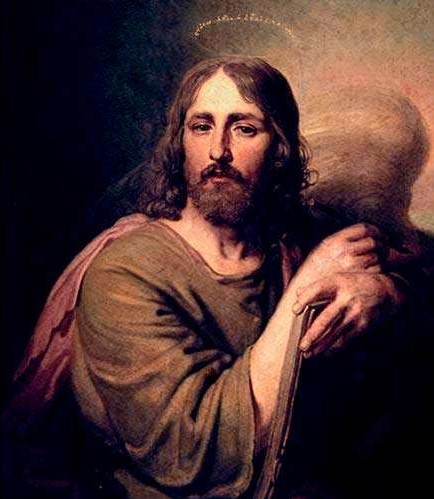
Gabriel then begins to break down the Messianic details on who would be the “fruit of [Mary’s] womb.” The angel explicitly says that Jesus would be the “Son of the Most High,” will sit on the “Throne of his father, David” (which has implications for Mary in the Davidic Covenant, which can be revisited at a later time) and that His Kingdom is eternal.
One detail that is downright important not to miss, is the how this will happen – the Virginal Conception. We are about to witness how Heaven will “kiss” earth, and how God the Father’s plan for His people will be accomplished “on earth, as it is in Heaven” in the Incarnation:
“The Holy Spirit will come upon you, and the power of the Most High will overshadow you.” (Luke 1:35)
Overshadow you. Here’s where a critical understanding of Scripture and typology is needed, and where our English language can fail us: this expression used by Gabriel is the same used in the Greek version of Exodus (40:35), which speaks of how God “overshadowed” the Tabernacle; his dwelling place among Israel. The implications in this text are that the Father will conceive by the power of the Holy Spirit, that the Christ will be the Son of God from the moment of conception, and that he will dwell with his people (Emmanuel, God with us) – just as he will dwell in his mother’s womb. Mary not only receives the mandate to “Mother” the Messiah, but to literally birth the incarnate Son of God. This is the role that Mary was predestined for in salvation history, although it wouldn’t end there. But for now, it’s clear why she is indeed blessed among women, and full of grace for this heavenly calling.

Finally, The Annunciation concludes with Mary’s submission to God’s word, in direct contrast to Eve’s disobedience in the Garden. As our church father St. Irenaeus said in the 2nd century:
“Mary the virgin is found obedient, saying, ‘Behold the handmaiden of the Lord; be it unto me according to your word.’ In contrast, Eve was disobedient … Having become disobedient, she was made the cause of death, both to herself and to the entire human race. Correspondingly, Mary … by yielding obedience, became the cause of salvation, both to herself and the whole human race … So it was that the knot of Eve’s disobedience was loosed by the obedience of Mary.” – St. Irenaeus
While there are many commentaries on Mary from our Ante-Nicene Church Fathers, Irenaeus’s words are consistently held in high esteem. He is directly linked to our church father Polycarp, who in turn was a disciple of John the Apostle, who alluded to the ‘creation account’ in Genesis throughout his Gospel; and who personally took care of Mary after Christ’s ascension. The amount of typology in John’s gospel is astonishing. At the absolute least Mary should be a celebrated as a “hero” in salvation history, along with the likes of Abraham or Moses, or the disciples, rather than passively ignored until Christmastime. At the absolute most, well, it may prove helpful to further pursue early Christian thought and exegesis from those who came before us – from those who are our heritage. If we can claim the doctrine of the Trinity without hesitation, and the canon of Scripture for that matter – surely, we need to look at what was said of Christ’s mother during this same period.
There’s much more to consider regarding this special woman – and many of our Church Fathers have written at length about her (Augustine, Ambrose, Origen, Justin Martyr to name a few). However, as much of this thesis find its home in Catholic thought, it seems fitting to close this piece with a quote from Martin Luther (one of his many “Marian” quotations):
“She became the Mother of God, in which work so many and such great good things are bestowed on her as pass man’s understanding. For on this there follows all honor, all blessedness, and her unique place in the whole of mankind, among which she has no equal, namely, that she had a child by the Father in heaven, and such a Child . . . Hence men have crowded all her glory into a single word, calling her the Mother of God . . . None can say of her nor announce to her greater things, even though he had as many tongues as the earth possesses flowers and blades of grass: the sky, stars; and the sea, grains of sand. It needs to be pondered in the heart what it means to be the Mother of God.” (Commentary on the Magnificat, 1521; in Luther’s Works, Pelikan et al, vol. 21, 326)
Let it be. There’s something about Mary.


Well written and great bridge between Catholic and Protestant thought on Mary.
LikeLike