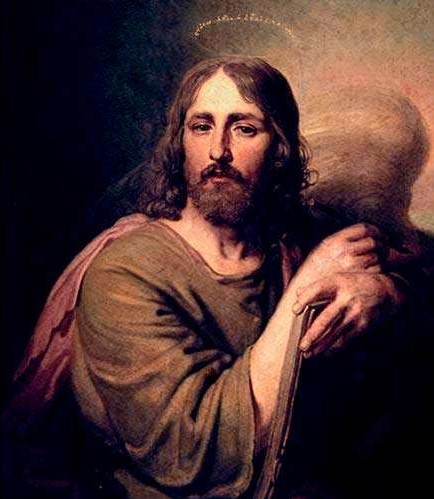
The Singing Theotokos

“All generations will call me blessed…” (Mary, Singing in her Magnificat, from St. Luke’s Gospel)

Let’s take a moment and picture ourselves in the newly restored Notre Dame in Paris, at a midnight mass in this beautiful, Gothic cathedral. What stands out to you? Perhaps you are taken with a choir singing in four-part harmony, with that majestic, historic organ pulsating in your chest. Or, maybe it’s the smell of incense and the soft glow of candles. The architecture is stunning. Perhaps your eyes dart between the centuries-old stained glass windows, telling the stories of Christ, until pausing on one of the rose windows. As you bring your gaze back to the front of the church, your eyes glance at the Notre-Dame de Paris – the Virgin Mother with the Christ Child. There is something particularly beautiful about this statue. Could it be that this image speaks of something true? Something transcendent? Regardless of our tradition, we all agree on its beauty. 
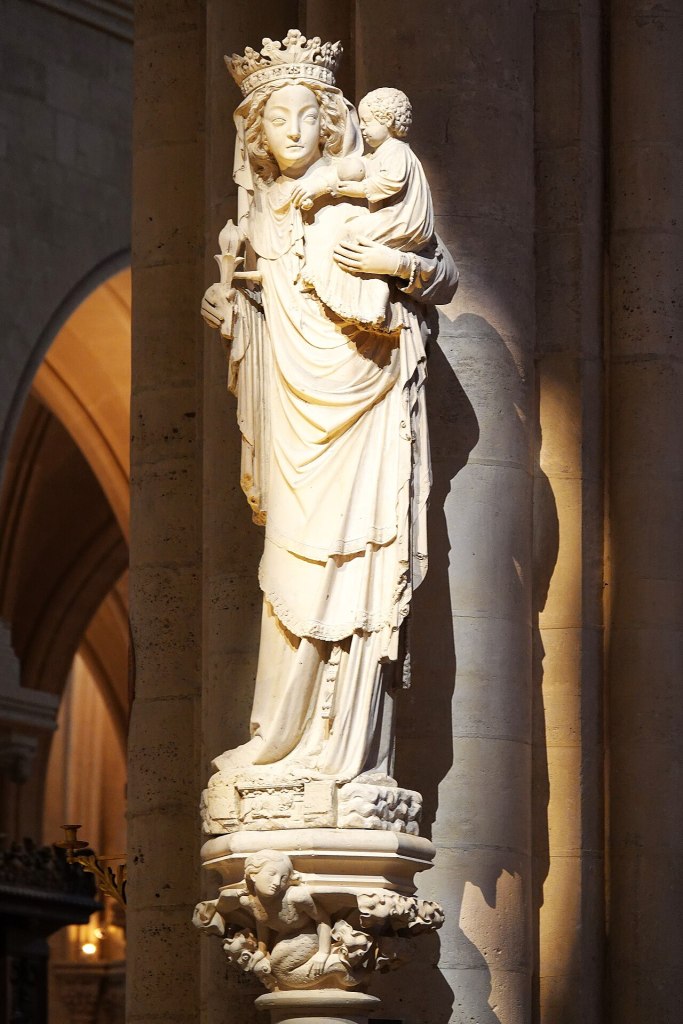
Notre-Dame de Paris, located in Notre Dame Cathedral in Paris, France

When looking at a work of art, one considers the intention of the artist, or the one commissioning the art. Is it possible that this famous statue was carved with reverence for God – for Christ and his Mother? Is it possible that the same Spirit who inspired composers to write great musical scores and hymns inspired this artwork? If we return to our thought experiment for a moment, to stare at the statue, to contemplate, are we made aware of any stirrings or questions?: … “Isn’t this just Roman, and pagan? Isn’t this Christendom assimilating Greco-Roman culture? Greek gods were also carved in stone… and yet – why do all ancient traditions of Christianity (both east and west) have the Virgin Mother and Christ Child portrayed in artwork?” … “Is this statue trying to teach me to see Mary in a particular way, and is it the way Christ intends me to see her?” … (for the biblically literate) “As Bathsheba was to King Solomon, is Mary the Queen Mother with her Son? How does this Old Testament principle work in the new covenant? Is she only crowned in this statue because we will be crowned in heaven, or is there more to it?” … (for the theologically minded) “What was Mary’s role in the mystery of the Incarnation? She carried Jesus in her womb… does it end there? How involved was she in his mission?” … “She is the Mother of Christ, and Christ is God the Son. What does that make her? She is ‘blessed among women,’ according to Luke’s Gospel, maybe her title should be “Blessed Mary?” … “Although, isn’t it because of excesses in the past that we don’t venerate her (except at Christmastime) – dare we provoke idolatry?”

Maybe Christians need a restoration of Mary, the Mother of God.

It needs to be pondered in the heart what it means to be the Mother of God.” (Martin Luther, Commentary on the Magnificat, 1521; in Luther’s Works, Pelikan et al, vol. 21, 326)

“Mary treasured all these words and pondered them in her heart.” (Luke 2:19)

If we have reservations, as this may upset our tradition, we can be assured that in the practice of faith, and in Christianity, there are many examples of how good things can be distorted: careless reading of scripture can produce legalism or heresy, soteriology (salvation theology) can produce triumphalism or an unhinged exclusivity, and the pursuit of biblical morality can lead to judgment and puritanism. Our view of Mary could indeed just be a distorted view that just needs to be rightly ordered.  If we aim upwards, in humility, asking honest questions, and asking the Holy Spirit to lead us, we can work towards a spiritual reality that is indeed healthy. While some may think it best to avoid her altogether because of past excesses, or worse, make a fictitious Netflix series, we in fact do need a restored perspective. If for no other reason than she is the Mother of Christ. Wouldn’t we defend our own Mother if there were errors in how people saw her? All Mariology should lead to Christology.

“Devotion to the Mother of our Lord in no way detracts from the adoration of her Divine Son. The brightness of the moon does not detract from the brilliance of the sun, but rather bespeaks its brilliance.” (Venerable Archbishop Fulton J. Sheen)

For many Christians, Mary is not likened to the moon – reflecting the light of her Son, but rather is more like the dark side of the moon, which aside from being a great album is not how we see things clearly. This is without doubt due to the various forms of restorationism throughout recent centuries after the Reformation; some of which demoted Mary to an incubator. However, to be fair, Mary is seen with varying degrees of light and clarity by different traditions (Catholic, Orthodox, Anglican, Lutheran, Presbyterian etc). What we will now look at is how Mary, indeed, is the Mother par excellence, and what that means for our personal faith journey.
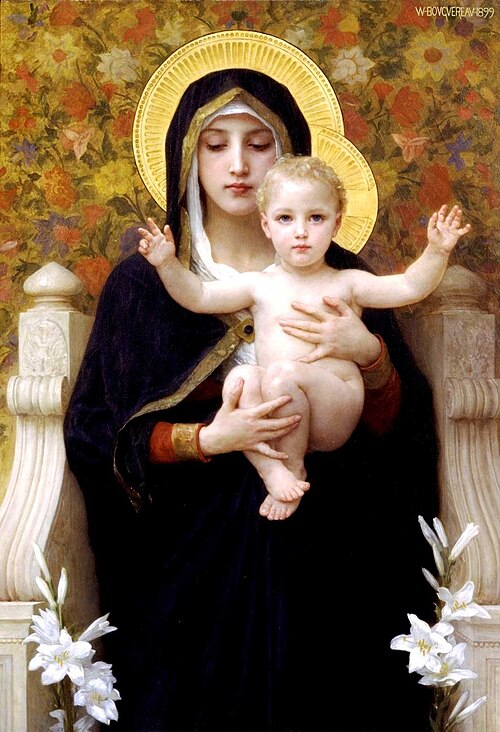
The Virgin of the Lilies (Fr: La Vierge au lys), by William-Adolphe Bouguereau (1899)

Mary, the mother of Jesus, not only conceived the Messiah, the Word made flesh, but mothered him. Her mandate was to raise him through his formative years, to nurture him, to teach him, to comfort him – and to prepare him for his divine calling. In every way, Mary was our Lord’s mother. Even at the cross, Mary never abandoned her son, but rather saw his mission to fulfillment – until “it [was] finished.” Mary even experienced suffering as she watched her son be mocked and crucified. This was as Simeon had prophesied to her at the presentation of the child Jesus at the temple:

“… and a sword will pierce through your own soul also…” (Luke 2:35)

Most Bible-believing Christians would affirm the above, but if we may delve into Catholic and Eastern Orthodox theology for a moment, according to tradition, it was at the cross that Jesus gave Mary to the Church, to Christians, to his “beloved disciples” – in giving her to St. John. This belief carries with it a perspective on the Communion of Saints that is not shared among Christian traditions. However, the proposition was that Jesus is the first born among many brethren, and all we have is his, including his Mother.

“When Jesus saw his mother and the disciple whom he loved standing beside her, he said to his mother, “Woman, here is your son.” Then he said to the disciple, “Here is your mother.” And from that hour the disciple took her into his own home. (John 19: 26, 27)
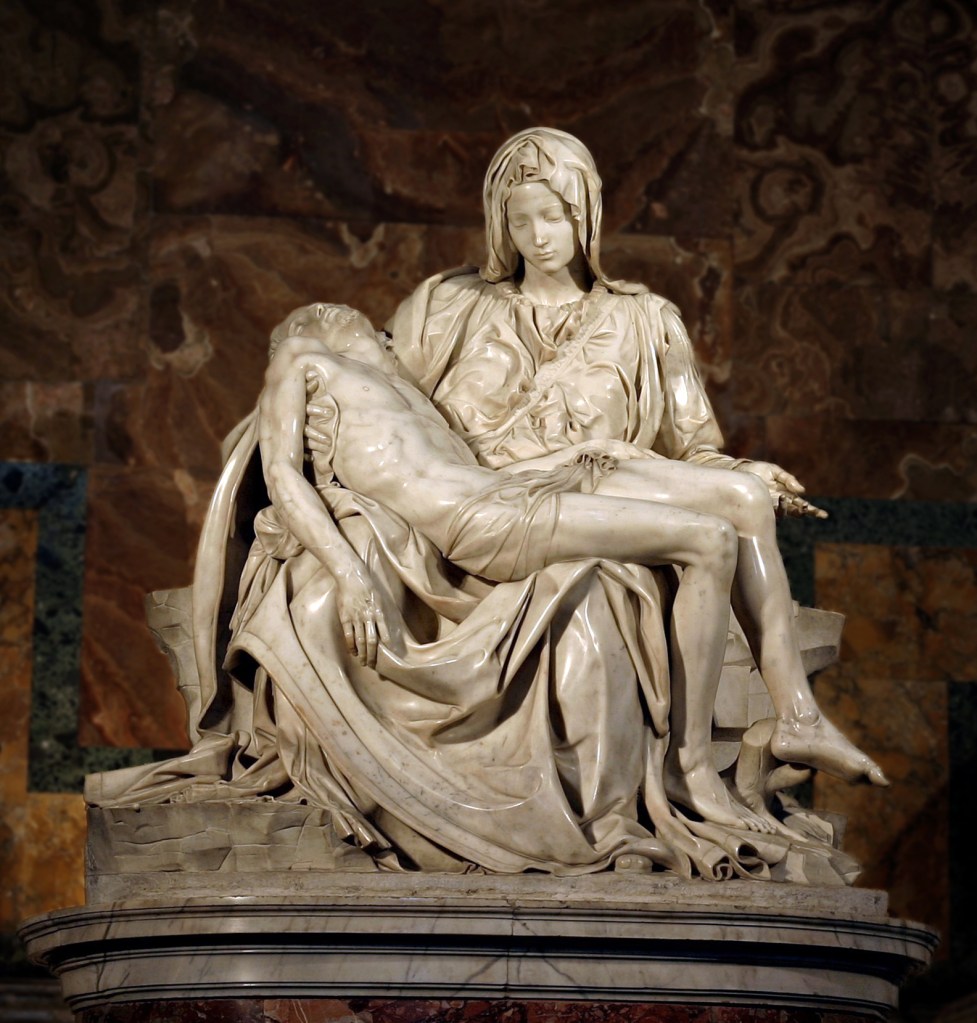
“Pietà,” by Michelangelo, located in St. Peter’s Basicilla (1498–1499)

Interestingly, at the time of the Reformation, even Martin Luther wrote at length regarding Mary’s maternity for all Christians:

It is the consolation and the superabundant goodness of God, that man is able to exult in such a treasure. Mary is his true Mother, Christ is his brother. God is his father. (Martin Luther, Sermon, Christmas, 1522)

Mary is the Mother of Jesus and the Mother of all of us even though it was Christ alone who reposed on her knees…If he is ours, we ought to be in his situation; there where he is, we ought also to be and all that he has ought to be ours, and his mother is also our mother. (Martin Luther, Sermon, Christmas, 1529).

This belief in Mary’s maternity for Christians seems to be held by Church Fathers, the early Christian Church, and has its roots deep in scripture. In the same way that Eve was the mother of the living, Mary became the mother of the Church. Eve was a type of Mary:

“Eve was called the mother of the living …after the fall this title was given to her. True it is…the whole race of man upon earth was born from Eve; but in reality it is from Mary the Life was truly born to the world. So that by giving birth to the Living One, Mary became the mother of all living.” (St. Epiphanius, Against Eighty Heresies, 78,9, written c. 374)

How is it that Mary is the Mother of the living, of the Church, by virtue of being the Mother of Christ? We will now move to the earliest Marian teaching of universal acceptance, one that is critical for Christianity and for the divinity of Christ, and we must start in Luke’s Gospel: When a pregnant Mary visits her cousin Elizabeth, she is crowned with a Spirit-filled proclamation of who she is, and who she carries (as John the Baptist “dances” in Elizabeth’s womb):

“And when Elizabeth heard the greeting of Mary, the babe leaped in her womb; and Elizabeth was filled with the Holy Spirit and she exclaimed with a loud cry, “Blessed are you among women, and blessed is the fruit of your womb! And why is this granted me, that the mother of my Lord should come to me?” (Luke 1: 41 – 43)
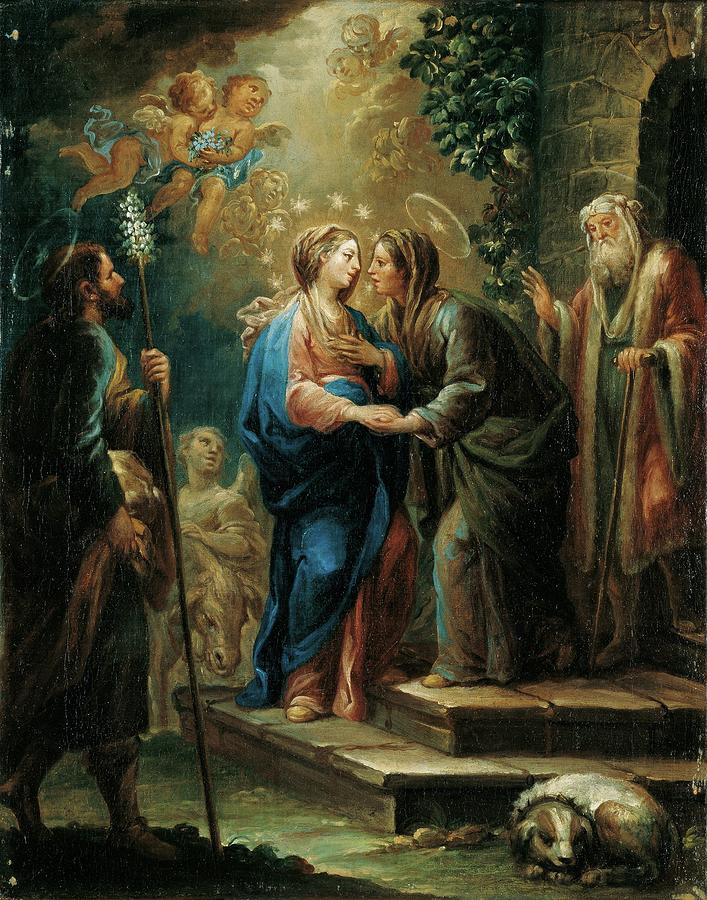
The Visitation, by Jerónimo Ezquerra (1737)

The mother of my Lord. The mother of Jesus. He who is God the Son; who carries two naturesdivine and human – united in one person. According to Christian theology, Mary gave birth to Jesus Christ, who was and is a divine person. Mary’s status is necessary for the doctrine of the Incarnation. Lest we fall into the gnosticism of the first centuries, we must ask: At what point did Jesus become divine? As the Nicene Creed stated against the heretics in the late 4th Century:

“…God from God, Light from Light, Begotten, not made, consubstantial with the Father … and by the Holy Spirit was incarnate of the Virgin Mary, and became man…”

Here is the key to this mystery: with this predestined vocation to be the Mother of Christ, Mary became Theotokos (Gk. God-bearer). This was Mary’s status, one of her names in the early church, through the first ecumenical councils and the canonization of the New Testament.

At this point, we must pause and state the obvious: Mary is a created being and did not give Christ’s divinity to him. Nor can it be said that she gave birth to God the Father, but rather that she conceived her child according to the Father’s will. Her submission to God, her “fiat” – enabled the mystery of the Incarnation. It is absurd to even suggest that somehow Mary is in any way equal to the Creator of the cosmos. Furthermore, it is heresy to say that Mary is in any way equal to Christ. Thankfully, no one of sound faith is saying this. Nevertheless, this ancient title was given to Mary, and was affirmed by the early Church – and fits in the most logical sense: if Jesus is God, and Mary is the mother of Jesus, she is indeed the mother of God. Mary did not give birth to a “nature” but to a person, and Christ’s divinity was not placed on him after his birth – that’s Gnostic language. We gain clarity when we read the words of the Angel Gabriel in the Gospel of Luke:

“The Holy Spirit will come upon you, and the power of the Most High will overshadow you; therefore the child to be born will be called holy, the Son of God. (Luke 1:35)

Mary, a created being, conceived Jesus, the God-Man – by the power of the Holy Spirit; so that the Jewish Messiah would bring divinity and humanity together at conception. This is the story of Salvation; of the divine life. This is how the logos can tabernacle among us (echoing the first chapter in John’s Gospel). We must remember that anything said of Mary is ultimately to magnify Christ and his redemptive mission. Joyfully, no one does this as beautifully as Mary herself, when she sings in her Magnificat. All Mariology must magnify Christology.

Madonna of the Magnificat, Sandro Botticelli
(1481)

“Him whom the heavens cannot contain, the womb of one woman bore. She ruled our Ruler; she carried Him in whom we are; she gave milk to our Bread.” (St. Augustine)

Again, Martin Luther, the key Reformer, even wrote at length regarding this belief:

God did not derive his divinity from Mary; but it does not follow that it is therefore wrong to say that God was born of Mary, that God is Mary’s Son, and that Mary is God’s mother . . . She is the true mother of God and bearer of God . . . Mary suckled God, rocked God to sleep, prepared broth and soup for God, etc. For God and man are one person, one Christ, one Son, one Jesus, not two Christs . . . just as your son is not two sons . . . even though he has two natures, body and soul, the body from you, the soul from God alone.” (Martin Luther, On the Councils and the Church, 1539)

(As an aside, the theological principle used to define Mary’s title is called the communication of idioms, which is to say: whatever is true regarding Christ’s two natures, is true about Christ himself. If Christ is God, and Christ was born in a manger, then God was born in Bethlehem – although God is surely eternal.)

Let’s close with some history. Mary’s given name as Theotokos declared Christ’s divinity among the heresies in the early years of Christianity. Early in the 5th century, the (heretic) Bishop Nestorius, along with some other theologians at the time, made known they disapproved of the title “Mother of God,” and preferred “Mother of Christ” – worried that it could imply Mary is somehow involved with Christ’s divinity. However, they also argued against Christ’s unified natures, saying the Virgin gave birth to Christ’s human nature, but not his divine nature; therefore, separating Christ’s unique quality as the God-Man. (Christians would still call these heresies today). The early Church disagreed, and Pope Celestine I strongly defended Mary’s given title. St. Cyril of Alexandria – a significant theologian of the day – came to the aid of these debates and affirmed that a mother does not give birth to a nature; but to a person. Though Mary did not “make” God, she most surely gave birth to Him. This ferocious debate evoked another ecumenical council to settle the dispute. Significantly, this council took place in Ephesus (431 A.D.), the city where tradition says Mary and John the Apostle lived after fleeing Jerusalem. This council was so critical for the early church, that passionate Christians from all over came to Ephesus – in torchlit procession – to wait for the council’s proclamation; and joyfully celebrated in the streets when the verdict was given, and Mary’s title was reaffirmed.

Byzantine mosaic of the enthroned Theotokos, Basilica of Sant’Apollinare Nuovo, Ravenna (c. AD 560)

This opens up a Pandora’s box of questions for Christians. If we accept the theology of the Theotokos, what does that matter to our personal faith journey? On the surface, solid ground is always better than shifting sand, and the truth of the Incarnation – namely, Christ’s divinity – is essential to Christianity. Sound doctrine matters. We might even come to terms with the fact that Mary is indeed in heaven, wearing a crown – just as Moses and Elijah are in heaven; and that she – in some way – undid the knot of Eve’s disobedience by her “yes” to bear God’s son. Maybe we even believe deep down that she is praying for us, as the saints in the Book of Revelation pray for us. But opening this idea of the “Communion of Saints” – interpreted as asking Saints in heaven to pray for us, is not the direction of this piece. Speaking of Revelation, maybe our restored Mariology will help us see the imagery of St. John’s Apocalypse (Chapter 12). However, Christians will have to come to their own convictions regarding what they can comfortably accept. Conscience is key. It seems at the very least that Christians should “call [her] blessed,” as she sang in her Magnificat.
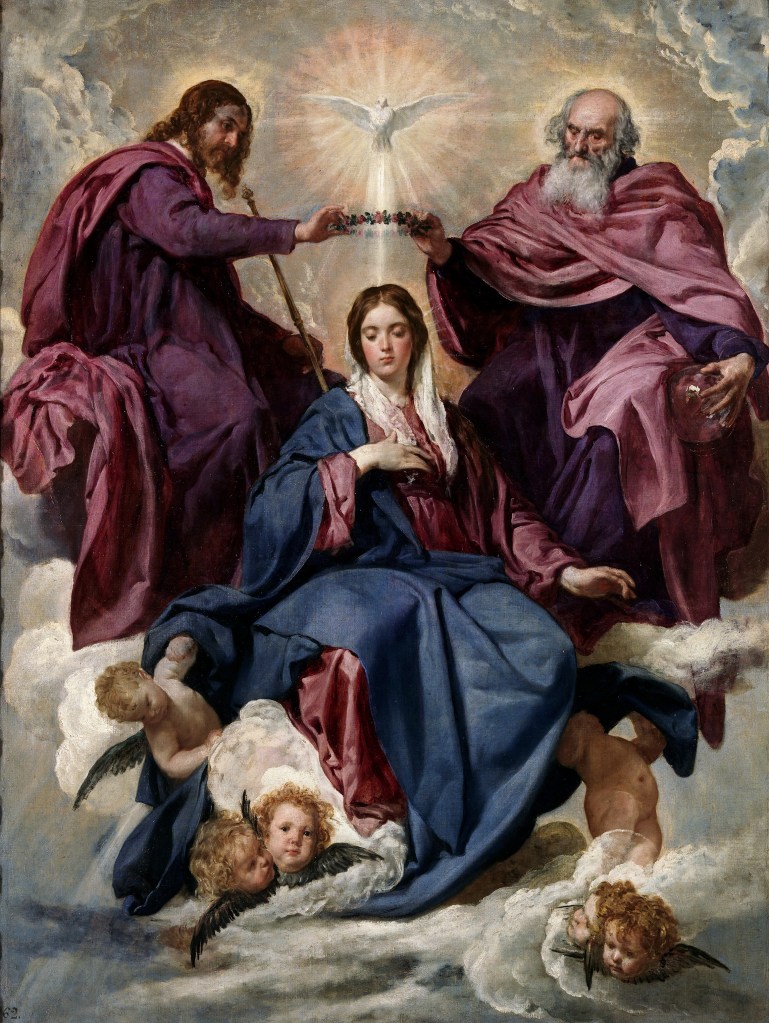
Coronation of the Virgin, by Diego Velázquez (1635-1636)

“Devotion to the Mother of our Lord in no way detracts from the adoration of her Divine Son. The brightness of the moon does not detract from the brilliance of the sun, but rather bespeaks its brilliance. The baptismal water does not detract from Christ’s power of regeneration. The preaching of men does not diminish the glory of God. Never has it been known that anyone who loved Mary denied the divinity of her Son. But it very often happens that those who show no love for Mary have no regard for the divinity of her Son. Every objection against devotion to Mary grows in the soil of an imperfect belief in the Son. It is a historical fact that as the world lost the Mother, it also lost the Son. It may well be that, as the world return to love of Mary, it will also return to a belief in the divinity of Christ.” (Fulton J. Sheen, Three to Get Married)
Interpreting Macbeth (and the Ever Virgin)

“The truth does not change according to our ability to stomach it.” ― Flannery O’Connor

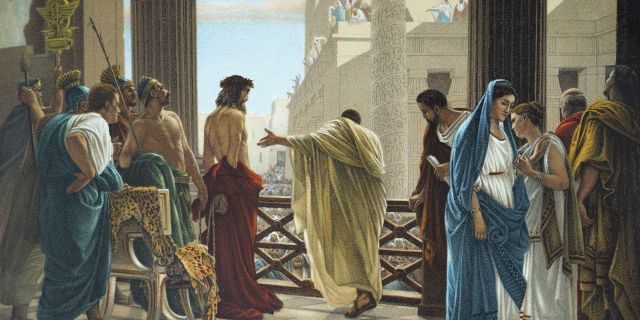
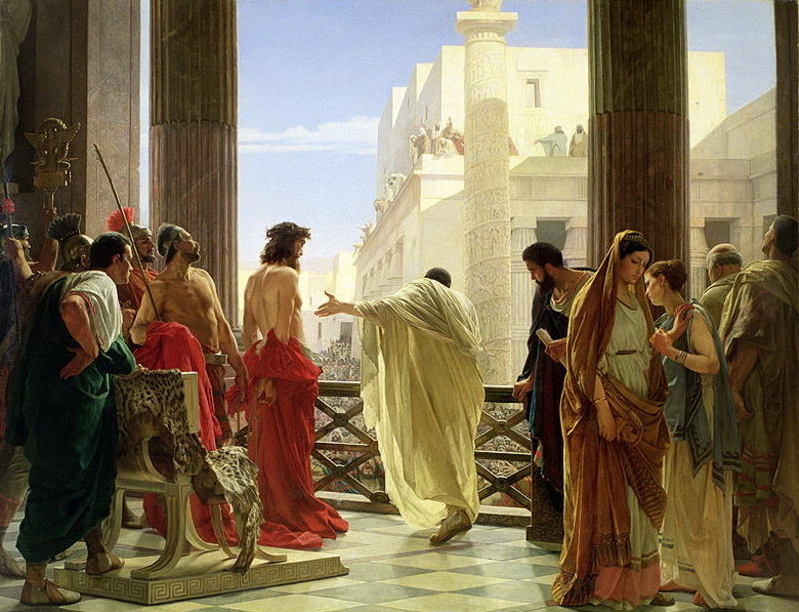
There’s a touching scene during Christ’s Passion, where the Roman governor Pontius Pilate takes Jesus aside – moments before his execution is carried out – and asks him privately, “So you are a king?” Picturing this exchange between the two of them is a rather intriguing image; particularly, the contrast between a Roman Official and a beaten, bloody Jewish Rabbi. The answer Christ gives is provocative, yet has a clarity normally reserved for personal conversations with his disciples:

“You say that I am a king. For this I was born, and for this I came into the world, to testify to the truth. Everyone who belongs to the truth listens to my voice.” (John 18:37)

Pilate must have hesitated for a moment – clearly perplexed, before he responded with “What is truth?”

Pontius Pilate showing Jesus to the crowds

Our modern era is one where media saturates culture and often dilutes many truths. As a Western culture, we’ve come from a place of accepting a universal truth – whether in science or philosophy – to a place of increased relativism; truth according to the individual. In many cases, one must even squint their eyes to find a sliver of “universal” truth. Press conferences are full of this – as the speaker is just off center enough to fall into the territory of a lie. While we like to reserve this seat for politicians and celebrities – even those who distribute news – modern, Western Christianity is especially prone to this.

As Christians, we’ve all given ear to a preacher as he gives his infallible interpretation on a passage of Scripture with charisma and a dose of passion; and we’ve most likely experienced moments when the interpretation disturbs something inside of us. It could be there is a “word” that challenges us – making us more conformed to Christ; the Holy Scriptures are intended for that. They are profitable for “…teaching, for reproof, for correction, and for training in righteousness.” However, it can also be the case where the words from the pulpit don’t quite sit right with our conscience, and this is problematic. John Henry Newman wrote, “Conscience is the aboriginal Vicar of Christ” – which means that our conscience is in some way connected to the source: the logos that created the world. Without a doubt, we are not aligned perfectly to this source – call it ignorance or original sin – but the reality is we cannot purely listen to our consciences.

The Holy Spirit, as depicted in stained glass.

Here is where the gift of the Holy Spirit is crucial, as God the Spirit is the inner “voice of Truth” in our hearts, affirming our conscience. Most Christians cling to this and listen for his voice, and in doing so – allow him to be their Shepherd. The Spirit does indeed teach, lead, convict and comfort and fills our hearts so we may receive the full rights of sonship. Nevertheless, some truths – particularly significant truths – are not given infallibly to us as individuals; or to a denomination for that matter. Many evangelicals are content to say: “Well, I have the Spirit in me, and the Bible – the Word of God, therefore I’m right, because the book says it!” (Or, perhaps with a softer demeanor, “God showed me this, therefore it’s true for me, even if it isn’t for you.”) This presents a deeply theological problem: Why would the Shepherd divide his flock? Why would our Father cause confusion among his children? Furthermore, why would the Creator drop Macbeth on our laps without a basic class in Shakespearean literature? How can we possibly interpret ancient, Holy Text? Jesus said that the Holy Spirit would “teach [us] everything” and “remind [us] of all that [he has] said to [us]” and finally, “guide [us] into all the truth” – which has to be true if we take his words seriously – and it is true in the day to day moments of our lives, as he leads us. However, we are living in a time where Christianity has evolved into tens of thousands of denominations, with directly contrasting “truths” – regarding even the fundamentals of Christian teaching (Baptism, Holy Communion, the Nature of Christ, the role of the Holy Spirit, Mariology, etc). Yet we preach that truth is not relative. As a wise man said in Fiddler on the Roof, “He’s right and he’s right, they can’t both be right!”

The Holy Scriptures

In addition to this, in recent centuries, we’ve experienced the origins of religious sects of christianity that are at their core not “Christian” – either because they deny Christ as God the Son, or they deny the Holy Spirit, or because they hold to a more polytheistic view of the cosmos. We’ve also seen the rise of New Age philosophy, even versions based loosely on Christian teaching. The fact is, as a Western culture, we love to take Jesus’ words and make them what we want them to say, as we skip over key texts; making him a prophet who affirms our brand of beliefs. This is dangerous. There was a word for this type of spiritualism in the early days of Christianity: Gnosticism.

This brings us back to the experience of a preacher who used his preferred English translation of the Holy Bible to proof text his systematic theology. This is not unique to clergy, as we all take our personal Bibles and do the exact same thing. We take an infallible Holy Text, and we assert our “infallible” interpretation of it (even if we don’t say we do). As the late Rich Mullins (who wrote modern hymns such as “Awesome God”) once said, “Most Protestants have no problem saying ‘The Lord told me this’ and ‘the Lord told me that,’ but they won’t believe that the Lord speaks through the Pope. At least the guy has some credentials.” Ironically, those who protest make themselves the Pope of their personal beliefs. There are many ways in which we do this, but to purposefully avoid hot button topics – as these can be revisited at another time – an intriguing illustration of how truth breaks down is in regard to the so-called “Brothers” of Jesus.

The Holy Family

To an outsider of the Church, this may seem petty, but for the sake of Christology and to validate the deposit of faith over the centuries, this is a critical topic for our conversation. Mary, the mother of Christ was declared ‘Ever Virgin’ (aeiparthenos, semper virgo) in the early days of Christianity; and this phrase remained one of her names through the Middle Ages, and into the Protestant confessional writings. Fast forward to the present day, and one would be hard-pressed to find an evangelical Protestant who holds to this view (with notable exceptions to some high church traditions).

“[Mary] remained a virgin in conceiving her Son, a virgin in giving birth to him, a virgin in carrying him, a virgin in nursing him at her breast, always a virgin.” (St. Augustine, Serm. 186, 1: PL 38, 999)

To be fundamentally clear, since the first ecumenical councils – through the Reformation – the Brothers of Jesus were either children of Joseph from a previous marriage, or – they were cousins of Christ, based on the Hebrew expression (the latter being the more favorable view). They were not, however, children of Christ’s Mother, Mary. This may seem heretical to certain Protestants today, but for the sake of our Christian faith we must press this further.

“Christ our Savior was the real and natural fruit of Mary’s virginal womb… This was without the cooperation of a man, and she remained a virgin after that.” (Martin Luther, Sermons on John, chaps. 1-4 (1539): Luther’s Works, vol. 22. p. 23, ed. Jaroslav Pelican, Concordia, 1957)

“The Blessed Virgin Mary, who, as well after as when she brought him forth, continued a pure and unspotted virgin.” (John Wesley, Founder of Methodism {“Letter to a Roman Catholic,” 1749 / In This Rock, Nov. 1990, p.25})

The simplest research will find a plethora of quotations, confirming that all the prominent Fathers’ of the Reformation held to Mother Mary’s perpetual virginity. That’s right – Luther, Calvin, Zwingli, Bullinger – even moving through the centuries to John Wesley. How could these brilliant minds who stood up to the religious establishment hold to this view? How could they – using sola scriptura – hold to a belief that we would argue today is seemingly not found in the Scriptures?

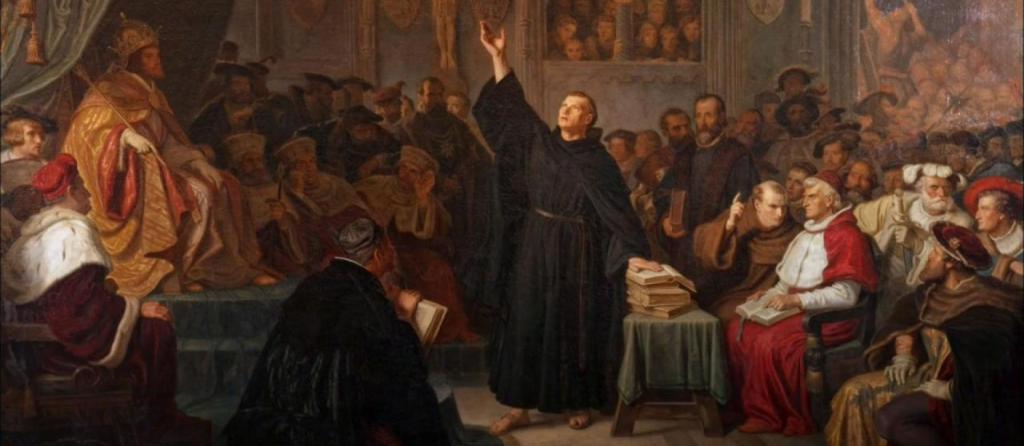
Martin Luther addressing the Church.

First, it seems reasonable to uphold that the Reformers understood the significance of the deposit of faith; particularly, the definitive writings of the early church fathers in the decades immediately after the Apostolic Age. Second, the Reformers were initially out to correct what they saw as corrupt inconsistencies in the Church, not re-write what was universally established; and they looked to doctors and heroes of the early faith like St. Augustine and St. Ambrose for confirming key doctrines in their confessions:

“Imitate her [Mary], holy mothers, who in her only dearly beloved Son set forth so great an example of material virtue; for neither have you sweeter children [than Jesus], nor did the Virgin seek the consolation of being able to bear another son” (Ambrose of Milan, Letters 63:111 [A.D. 388])

It is a historical fact that our Christian heritage has always affirmed the Brothers of Christ weren’t children of Mary and yet they were his “relatives.” How do we make sense of this?

“Under the word ‘brethren’ the Hebrews include all cousins and other relations, whatever may be the degree of affinity.” (John Calvin, {Pringle, ibid., vol. I, p. 283 / Commentary on John, (7:3)})

If we take a closer look at the Greek word used to translate what we know in English as “brothers” or “brethren,” we may begin to find some clarity. The word is adelphoi, which was used throughout the Septuagint (Greek Old Testament) to translate a broader Hebrew word that meant “family relations.” There was no word in ancient Hebrew for “cousin,” so it was regular practice to use “brethren” in the Old Testament for relationships other than blood brothers. While there are many examples of this, one key example is the relationship between Abraham and Lot – an uncle and a nephew – in Genesis 13:8. In fact, adelphoi is also used primarily to talk about the new Christian family (“brothers & sisters”) in the letters of the New Testament.

“Christ . . . was the only Son of Mary, and the Virgin Mary bore no children besides Him . . . “brothers” really means “cousins” here, for Holy Writ and the Jews always call cousins brothers. (Martin Luther, Sermons on John, chapters 1-4, 1537-39)”

If we apply a simple exegesis to the gospels, there is evidence that affirm the wider use of this word. First, Jesus’s brothers are never called “Children of Mary” – where Jesus himself is. Second, the “other Mary” at the tomb in Matthew’s Gospel is a different Mary than the Mother of Christ (and she’s the mother of James & Joseph). Third, in John’s Gospel, Jesus gives his mother to John the Apostle, which culturally wouldn’t make sense if she had other children to take care of her. Furthermore, our early church historian Eusebius – who we rely on when defending the historical accounts of our faith – gives us some clarity in his account: The Church History. When talking about the Martyrdom of James, Bishop of Jerusalem, Eusebius presents a relationship between some of the “Brothers’ of Christ” as children of Clopas, who is the husband of Mary, wife of Clopas; who is related to Christ’s mother, and is one of at least three Mary’s at the cross in John 19 (as “Marian” was a popular name). Clopas, in turn, is related to Christ’s extended family through Joseph. It’s important to note that Eusebius wasn’t defending Mary’s perpetual virginity, but rather giving an account of the beginnings of the church. He was affirming what many early Church Fathers’ – like Origen – had already given testimony to:

“No one can understand the meaning of [the Gospel of John] unless he has lain on Jesus’ breast and from Jesus has received Mary to be his mother, too. Such a person must he become who is to be another John… For if Mary – as those say who extol her with sound mind – had no other son but Jesus, then He virtually said to Her, “Look! This is Jesus, whom you did bear.” (For He did not say to His mother, “Behold, you have this son also,” but “Woman, behold your son.”) Is it not the case that everyone who is perfect, lives for himself no longer? Does not Christ live in him? And if Christ lives in him, then it is said of him to Mary, “Behold, your son, Christ.” What a mind, then, we must have to enable us to interpret this work [the Gospel of John] in a worthy manner.” (Origen, 228 A.D.)

If we continue this thread through our early Christian heritage, we see Mary in the Creeds rightfully called the Virgin Mary – as if it’s essential to her name. If we read the writings of the Church Fathers’– especially those of doctrinal significance, we find this belief held to without reservation. In fact, when the proposition is even made that Mary may have had other children – which was suggested by Helvidius in the late 4th century – the Doctors’ of our faith came against this teaching with the same fervor they did other heresies of that time. St. Jerome (who translated the Greek texts into the Latin Vulgate) opened his letter to Helvidius in unwavering fashion:

“I must call upon the Holy Spirit to express His meaning by my mouth and defend the virginity of the Blessed Mary. I must call upon the Lord Jesus to guard the sacred lodging of the womb in which He abode for ten months from all suspicion of sexual intercourse. And I must also entreat God the Father to show that the mother of His Son, who was a mother before she was a bride, continued a Virgin after her son was born. We have no desire to career over the fields of eloquence, we do not resort to the snares of the logicians or the thickets of Aristotle. We shall adduce the actual words of Scripture. Let him be refuted by the same proofs which he employed against us, so that he may see that it was possible for him to read what is written, and yet to be unable to discern the established conclusion of a sound faith.” (St. Jerome, Against Helvidius)

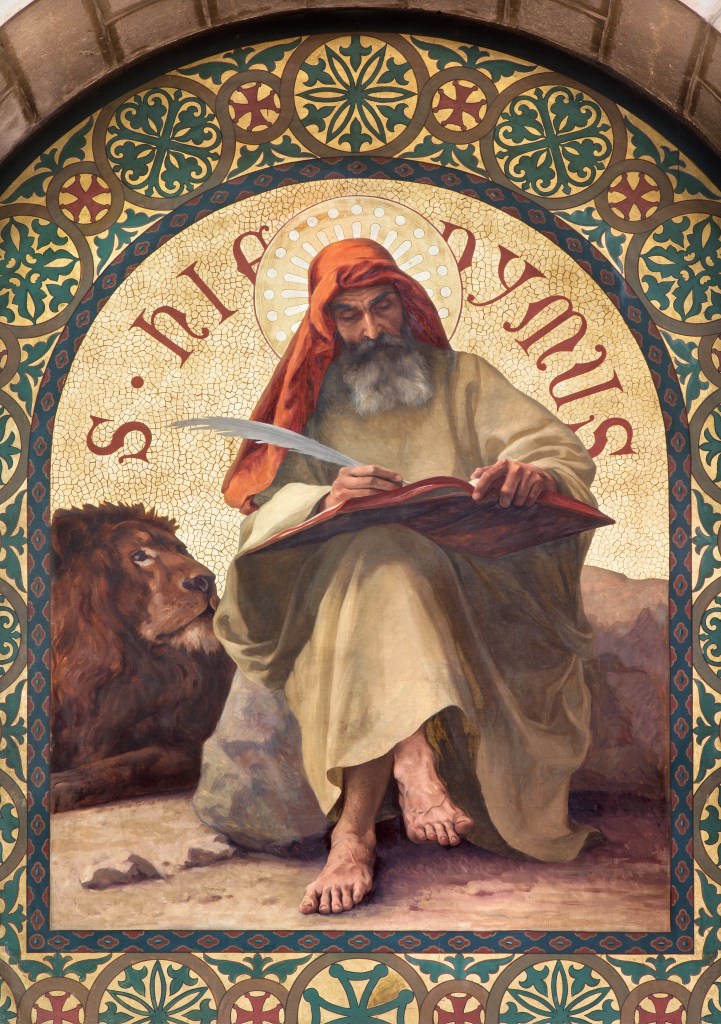
St. Jerome

For Protestants, John Calvin affirmed this standpoint over a millennium later:

“Helvidius displayed excessive ignorance in concluding that Mary must have had many sons, because Christ’s ‘brothers’ are sometimes mentioned.” (John Calvin, {Harmony of Matthew, Mark & Luke, sec. 39 (Geneva, 1562), vol. 2 / From Calvin’s Commentaries, tr. William Pringle, Grand Rapids)

Herein lies the issue: in the present day, we take a word like “brothers” and read it in light of our current understanding; without paying regard to what that word was translated from, or how it was interpreted through course of our Christian lineage. Now we must ask an uncomfortable question: Are there other ways in which we do this? Are there beliefs we hold to that are not fundamentally grounded in Scripture and Christian tradition? To be fair, this is no fault of our own as personal readers, and we can claim a certain amount of ignorance prior to this point. However, what this does prove is that Christians need a deeper understanding of the Holy Scriptures – both regarding the continuity and typology previously established, and even regarding issues with translation. Christians need to be open to pursuing the deposit of faith; the straight line of our heritage, our history. If we don’t pursue these established pillars of our faith, we stay content with the preacher who used their English translation to preach with full authority based on their own understanding; which is ultimately dangerous. We cannot preach something as “Christian truth” unless it is indeed truth.

(As an aside, it may be tempting to say, “why does it matter if Mary did or did not have other children?” The truth is, a solid Mariology always leads to a grounded & glorified Christology. Mary’s very soul “magnifies” Him. The minute we “domesticate” Christ’s Mother, we tamper with the truth of the Incarnation of the Word made Flesh. This is one reason why we have denominations today that do not hold to Christ’s deity, and why our culture – post enlightenment – has looked at Jesus as merely a human prophet. It’s a slow burn.)

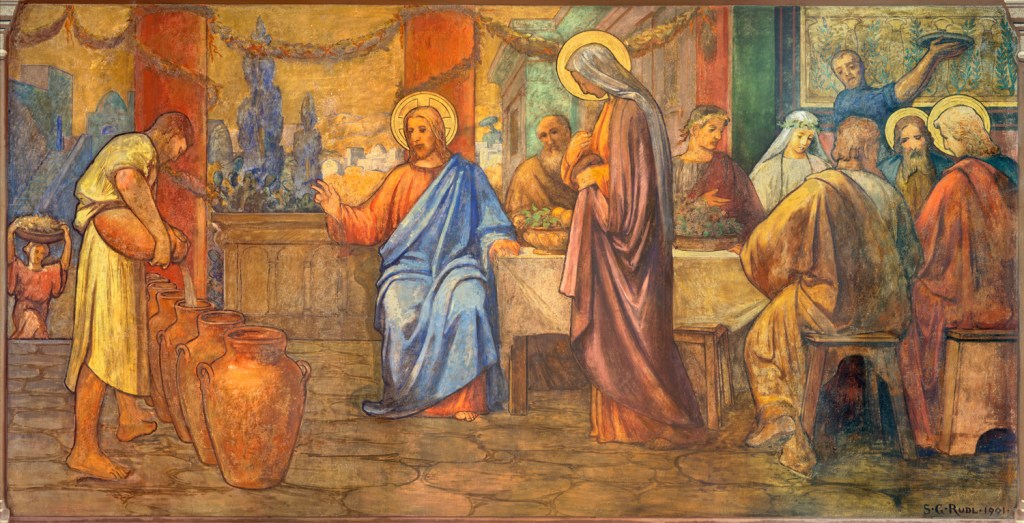
Jesus and Mary at the Wedding at Cana

If we pursue the truth, we will find it. If we seek, we will find. Jesus promised us this. He is ultimately the Way, the Truth and the Life. He will lead us in paths of righteousness. We must cooperate with him by striving to look past our denominations – our personal beliefs – and into what has been revealed to the Christian Church since the beginning of this revolution, and over the centuries. There is no “gap theory” regarding our history, or else the gates of hell have prevailed. We must break our constant trend of blowing everything up and “starting over;” as if our version of restorationism is the correct one. The Holy Spirit has been guiding the church since the beginning – despite issues of division and corruption. There is truth that is not relative, and this truth is worth the pursuit. If we can open ourselves to what the Church taught for much of its existence, we can perhaps find a unity that has evaded us as Christians in more recent centuries.

“If you believe what you like in the Gospels, and reject what you don’t like, it is not the Gospel you believe, but yourself.” — St. Augustine

That We May Be One

“To love is to will the good of the other.” – St. Thomas Aquinas

Our culture is now more contentious than ever before. Social media has given us false authority to detach our common humanity – our shared Imago Dei – from our personal convictions. Rather than “will the good of the other,” we are built up by tearing each other down. We see this on our Late shows, our news, our YouTube personalities, our Facebook pages and even in one-on-one conversation. As believers, we either see this as the “evil” side of the spectrum trying to overtake the “good” side (but then we must agree on what the “good” side is), or, we possibly see it as forces outside ourselves causing hate and disunity – with a more disturbing agenda in mind. Surely, this is the moment when the Church will rise to heal the world through the unified Gospel of our Lord Jesus Christ – the Savior of the World! And yet, there is a sad sense of irony to that statement.

Jesus praying, as depicted in ‘The Bible’ (miniseries)

On the eve of his death by crucifixion, Jesus prayed a theologically rich prayer, which we call his “High Priestly Prayer,” and asked the Father that “they (believers) may be one even as we (Christ and the Father) are one.” Can you imagine if Christians had a sort of “Trinitarian Oneness?”

“I do not ask for these only, but also for those who will believe in me through their word, that they may all be one, just as you, Father, are in me, and I in you, that they also may be in us, so that the world may believe that you have sent me.” (John 17: 20, 21)

Jesus gives us a glimpse of what could be the result of this type of unity: that the world may believe. Whether we admit it or not, our unity as Christ-followers is directly linked to our mandate for this world – the Great Commission.

Billy Graham and Pope John Paul II

To be fair, there have been significant, sincere efforts towards ecumenism, which are to be celebrated (one remembers Pope John Paul II clutching Billy Graham’s thumb, and telling him, “We are brothers”), and we can speak at length of Christians overcoming centuries of conflict for the sake of the Christ. However, despite these efforts, on almost every point of Christian doctrine there is discord between denominations. To be clear, these are ruptures that wound the unity of Christ’s body. We cannot be the light of the world effectively if we aren’t truly one body. As Christ put it, a “house divided against itself shall not stand” (Matt 12:25)

“Where there is division, there is sin.” (Origen)

When the Apostle Paul wrote his first letter to the church in Corinth, he immediately called out the disunity among believers – with a sense of urgency:

“I appeal to you, brothers, by the name of our Lord Jesus Christ, that all of you agree, and that there be no divisions among you, but that you be united in the same mind and the same judgment.(1 Cor 1:10)

He then addressed the specific reports of disagreements among believers:

“What I mean is that each one of you says, “I follow Paul,” or “I follow Apollos,” or “I follow Cephas,” or “I follow Christ.” Is Christ divided? Was Paul crucified for you? Or were you baptized in the name of Paul?” (1 Cor 1:12, 13)

We must drive the point home by playfully changing the names:

“What I mean is that each one of you says, “I follow Calvin,” or “I follow Knox,” or “I follow Wesley,” or “I follow Christ.” Is Christ divided? Was Luther crucified for you? Or were you baptized in the name of Luther?”

Of course, we could add other names to this example – even more obscure names like Joseph Smith – but the result remains the same.

At this point, it seems right to briefly address these wounds to unity.

St. Paul, writing his letters.

Historically speaking, if you were to draw a line from the time of Christ until the present age, you would find three key moments of division (excluding of course, fragments lost to non-Christian, gnostic heresies such as Arianism):

1) The disagreement with the Egyptian (Coptic, Oriental) church in 451.

2) The East-West Schism of 1054.

3) The Protestant Reformation of the 16th century.

(As an aside, Protestants must be careful not to romanticize the Reformation as if it were a sort of mythological story of triumph – where Robin Hood upsets the unjust throne of Prince John – or worse, where God’s chosen people escaped the tyrannical rule of Egypt. To hold a view of this sort is to be ignorant of the whole picture. It is worth noting that after this religious and political division, our beloved Christianity shattered into thousands of denominations, and as we all know, blood has been shed over petty differences.)

Aside from the ripple effect of the Protestant Reformation, the earlier disagreements were relatively minor in retrospect – especially in regards to doctrine – and the universal Church still collectively held to much of the same teachings (Eucharist, Baptism, Sacraments, Holy Scriptures, etc). It wasn’t until the Reformation, where many (and at times, contradictory) ideas appeared. This makes sense in light of that period in history – particularly regarding the printing press; the political tensions of the North and South; and the pre-Enlightenment mentality that was starting to rise. Ironically, Martin Luther himself recognized the divisions immediately happening at that time:

“This [denomination] won’t have baptism, that [denomination] denies the efficacy of the Lord’s supper; a third, puts a world between this and the last judgment; others teach that Jesus Christ is not God; some say this, others that; and there are almost as many sects and beliefs as there are heads.” (Martin Luther, Letter to Antwerp, 1525)

“There is one body and one Spirit—just as you were called to the one hope that belongs to your call—one Lord, one faith, one baptism, one God and Father of all, who is over all and through all and in all.” (Eph 4:4-6)

We can celebrate the fact that believers on all sides of the aisle hold to the above verse, and many of us long for the unity of “one body and one Spirit.” This we can attribute to the Fruit of the Holy Spirit at work in our hearts. But now we must ask a sincere question: How do we heal from this sinful state of division? Or, rather: How can we draw closer together, to advance our Father’s kingdom on earth as it is in Heaven? How can we be one so that the world may believe? The answer isn’t in a chorus of “kumbaya” – ignoring significant differences – as this wouldn’t be true to our convictions. To heal takes time. It takes a change of heart. We must first be willing to look past ourselves – our tradition, our convictions – and to be deep in history (which means to know where we came from, our heritage, and why we believe what we profess); rather than holding spiritual beliefs based on comfortable assumptions. To do this is to pursue the virtue of humility, which is presumably characteristic of a true Christian.

To drive this point further, it is true that many denominations are a result of restorationism; which is the pursuit of rediscovering the early church (the “true” church) based on Sola scriptura. While admirable, these movements tend to be led by individuals and not a collective whole, and are ignorant of the history of the church, and use proof texts from the Holy Scriptures that are out of context at best, or heretical at worst. As a possible step forward, it would seem logical to investigate the Ante-Nicene Fathers, who have tremendous testimony (undoubtedly full of the Holy Spirit) – who were persecuted under different emperors – and who wrote to combat heresies on their way to martyrdom. In fact, some of these Fathers are ‘apostles of apostles’ – and have much to say regarding Christian Practice and belief in the decades immediately after Christ.

(As an aside, we must also remember that it is the witness of these Church Fathers that we credit with validating the texts in our New Testament canon, as they quoted from those texts before we had complied them – at the end of the 4th Century).

Kildalton Cross, Islay, Scotland

Finally, many of the doctrines Christians assume always existed – such as the doctrine of Christ as one in Being with the Father, and the Spirit who proceeds from the Father and the Son (I.E. the Trinity) – and the person of Christ as two natures, divine and human, united in one person – were a result of unified Church Councils opposing heresies that arose in the first few centuries. Whether we admit it or not, we are standing on the shoulders of the Church Fathers. One of our beloved early Fathers is St. Irenaeus – who was taught by Polycarp (who was taught by John the Apostle). His writings (Against Heresies) contain significant theological truths, as well as a window into the beliefs and state of the church in the 2nd Century:

“Indeed, the Church, though scattered throughout the whole world, even to the ends of the earth, having received the faith from the apostles and their disciples … guards [this preaching and faith] with care, as dwelling in but a single house, and similarly believes as if having but one soul and a single heart, and preaches, teaches, and hands on this faith with a unanimous voice, as if possessing only one mouth.” – (St. Irenaeus, Adv. haeres. 1, 10, 1-2)

One further thought, it’s useful to liken these divisions to a sort of “divorce” – and why is divorce allowed to be pursued? – as Christ said, because of our “hardness of heart.” Healing starts with the softening of our hearts, the virtue of charity, the Fruits of the Spirit, and an openness to look past our understanding.

We must encourage each other as believers to “know our roots” (one might think of an Ancestry TV show) and not to settle for our own personal heritage. We must pursue what does unite us: the traditional faith that was passed down from the beginning. For as we know, Jesus promised the Spirit would guide [us] into all the truth and that means throughout the centuries. We have a cloud of witnesses who stand before us.

To quote the Catechism of the Catholic Church, which integrates the previously stated Origen quote, beautifully:

“Where there are sins, there are also divisions, schisms, heresies and disputes. Where there is virtue, however, there also are harmony and unity, from which arise the one heart and one soul of all believers.” (CCC 817)

“So that the world may believe that you have sent me.”

Mary, Mother of Christ

“When I find myself in times of trouble, Mother Mary comes to me, speaking words of wisdom, let it be.” – Paul McCartney

While it’s doubtful Paul had a Marian apparition, nor any Beatle – and to be clear, this lyric is inspired by his own mother – it seems right to open this piece with a beautiful, familiar melody in mind. Music has the spiritual ability to soften our hearts, calm our minds, and in this case, enable us to receive a thesis based on biblical exegesis (and not to worry, we surely won’t contrive theology from this lyric).

With the season of Advent upon us, as Christians around the world prepare their homes for Christmas, it may prove helpful to meditate on certain mysteries from this “greatest story ever told.” One beloved but often misunderstood individual in the Nativity story is Mary, the Mother of Christ. Regardless of where Christians choose to land in their feelings towards her, there are profound truths that we need to investigate with open hearts.

An outsider of the Church might be surprised to find that we (Christians) have different perceptions on the Mother of our Savior; the woman predestined by God the Father to be the mother of the incarnate “Word made flesh.” A student of history can see this is no doubt due to “excesses” practiced at certain times in our church history. However, what is equally true is that we have since dramatically “thrown out the baby with the bath water,” or rather, “severed the mother from the baby.” So as Christians put out their Nativity scenes, with a statue (“graven image”) of Mary, it seems right to pursue an understanding of who this woman is.

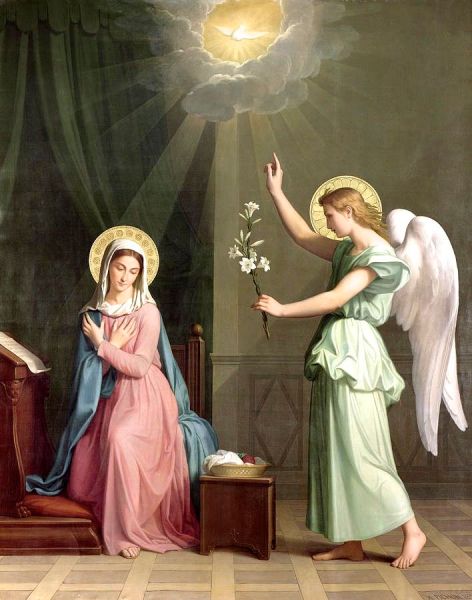
The Annunciation

To be fundamentally clear from the start, everything said, written – and dare we say, exalted – of Christ’s mother is meant to be deflected to God the Creator. This invokes the image of an Artist and their masterpiece. When we comment on the beauty of an Artist’s work, we are not taking glory away from the Artist – on the contrary, we are glorifying his creative process! His creation! His purposes! Is it possible to “Rejoice” in what God has done for Mary, as she does in her Magnificat found in the Infancy Narrative in the Gospel of Luke?

When a Spirit-filled Elizabeth exalts her cousin – “Blessed are you among women, and blessed is the fruit of your womb!” – Mary’s response proves the intention of her heart; namely, to glorify her Son:

“My soul magnifies the Lord, and my spirit rejoices in God my Savior, for he has regarded the low estate of his handmaiden. For behold, henceforth all generations will call me blessed; for he who is mighty has done great things for me, and holy is his name.” (Luke 1:46-49)

If Mary is elevated above Christ, it is us at fault, and not Mary – as her heart is to stir affection for her Son, our Savior. Just as a masterpiece stirs our affection for the Artist. She is forever a “handmaiden of the Lord” who “all generations will call blessed” – although many haven’t for centuries. To drive the point home further, Mary’s very being magnifies her Son. As Archbishop Fulton J. Sheen put it:

“God who made the sun, also made the moon. The moon does not take away from the brilliance of the sun. All its light is reflected from the sun. The Blessed Mother reflects her Divine Son; without Him, she is nothing. With Him, she is the Mother of men.”

Returning to the season of Advent, the first of these mysteries to explore is the Annunciation, found in beginning of Luke’s Gospel, seemingly given from the perspective of Mary herself. The narrative opens, with God’s heavenly messenger, Gabriel, addressing Mary – although not by name – with what we’ve translated as “Hail” (Ave), “Rejoice” or “Greetings;” which indicates a sort of royal greeting, a joyful invitation, a certain “wooing” – and it guides us to the Father’s affection for this woman. Then follows the unique Greek word kecharitomene, which was translated “full of grace” (gratia plena) for centuries, and in modern history translated “thou that art highly favored,” or “O favored one.” The implications Luke seems to want to convey in this single word require thoughtful research. For the sake of the piece – as one can find specifics nowadays, the implication is that Mary had been endowed with grace for this divine task. This word implies that she was predestined; graced – and yet still called. From this perspective, it seems appropriate that the angel proclaims this word to Mary as if it’s her new name – in the same way God changed Abram’s & Jacob’s names, and Jesus changed Simon’s name. (Also, it’s worth noting that this is the only time this Greek word is used in the Scriptures, and, according to research, found nowhere else in Greek literature. What a word St. Luke chose to use to describe her.)

Gabriel then begins to break down the Messianic details on who would be the “fruit of [Mary’s] womb.” The angel explicitly says that Jesus would be the “Son of the Most High,” will sit on the “Throne of his father, David” (which has implications for Mary in the Davidic Covenant, which can be revisited at a later time) and that His Kingdom is eternal.

One detail that is downright important not to miss, is the how this will happen – the Virginal Conception. We are about to witness how Heaven will “kiss” earth, and how God the Father’s plan for His people will be accomplished “on earth, as it is in Heaven” in the Incarnation:

“The Holy Spirit will come upon you, and the power of the Most High will overshadow you.” (Luke 1:35)

Overshadow you. Here’s where a critical understanding of Scripture and typology is needed, and where our English language can fail us: this expression used by Gabriel is the same used in the Greek version of Exodus (40:35), which speaks of how God “overshadowed” the Tabernacle; his dwelling place among Israel. The implications in this text are that the Father will conceive by the power of the Holy Spirit, that the Christ will be the Son of God from the moment of conception, and that he will dwell with his people (Emmanuel, God with us) – just as he will dwell in his mother’s womb. Mary not only receives the mandate to “Mother” the Messiah, but to literally birth the incarnate Son of God. This is the role that Mary was predestined for in salvation history, although it wouldn’t end there. But for now, it’s clear why she is indeed blessed among women, and full of grace for this heavenly calling.

“Behold, I am the handmaid of the Lord; let it be to me according to your word.”

Finally, The Annunciation concludes with Mary’s submission to God’s word, in direct contrast to Eve’s disobedience in the Garden. As our church father St. Irenaeus said in the 2nd century:

“Mary the virgin is found obedient, saying, ‘Behold the handmaiden of the Lord; be it unto me according to your word.’ In contrast, Eve was disobedient … Having become disobedient, she was made the cause of death, both to herself and to the entire human race. Correspondingly, Mary … by yielding obedience, became the cause of salvation, both to herself and the whole human race … So it was that the knot of Eve’s disobedience was loosed by the obedience of Mary.” – St. Irenaeus

While there are many commentaries on Mary from our Ante-Nicene Church Fathers, Irenaeus’s words are consistently held in high esteem. He is directly linked to our church father Polycarp, who in turn was a disciple of John the Apostle, who alluded to the ‘creation account’ in Genesis throughout his Gospel; and who personally took care of Mary after Christ’s ascension. The amount of typology in John’s gospel is astonishing. At the absolute least Mary should be a celebrated as a “hero” in salvation history, along with the likes of Abraham or Moses, or the disciples, rather than passively ignored until Christmastime. At the absolute most, well, it may prove helpful to further pursue early Christian thought and exegesis from those who came before us – from those who are our heritage. If we can claim the doctrine of the Trinity without hesitation, and the canon of Scripture for that matter – surely, we need to look at what was said of Christ’s mother during this same period.

There’s much more to consider regarding this special woman – and many of our Church Fathers have written at length about her (Augustine, Ambrose, Origen, Justin Martyr to name a few). However, as much of this thesis find its home in Catholic thought, it seems fitting to close this piece with a quote from Martin Luther (one of his many “Marian” quotations):

“She became the Mother of God, in which work so many and such great good things are bestowed on her as pass man’s understanding. For on this there follows all honor, all blessedness, and her unique place in the whole of mankind, among which she has no equal, namely, that she had a child by the Father in heaven, and such a Child . . . Hence men have crowded all her glory into a single word, calling her the Mother of God . . . None can say of her nor announce to her greater things, even though he had as many tongues as the earth possesses flowers and blades of grass: the sky, stars; and the sea, grains of sand. It needs to be pondered in the heart what it means to be the Mother of God.” (Commentary on the Magnificat, 1521; in Luther’s Works, Pelikan et al, vol. 21, 326)

Let it be. There’s something about Mary.