“The truth does not change according to our ability to stomach it.” ― Flannery O’Connor
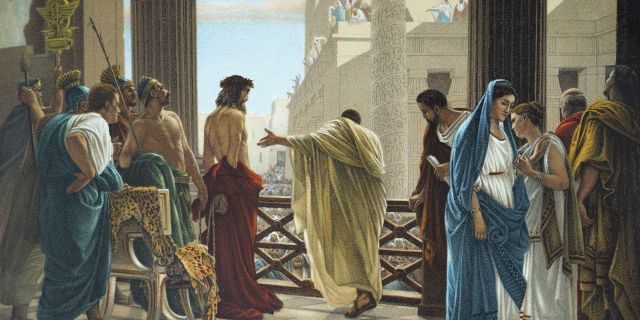
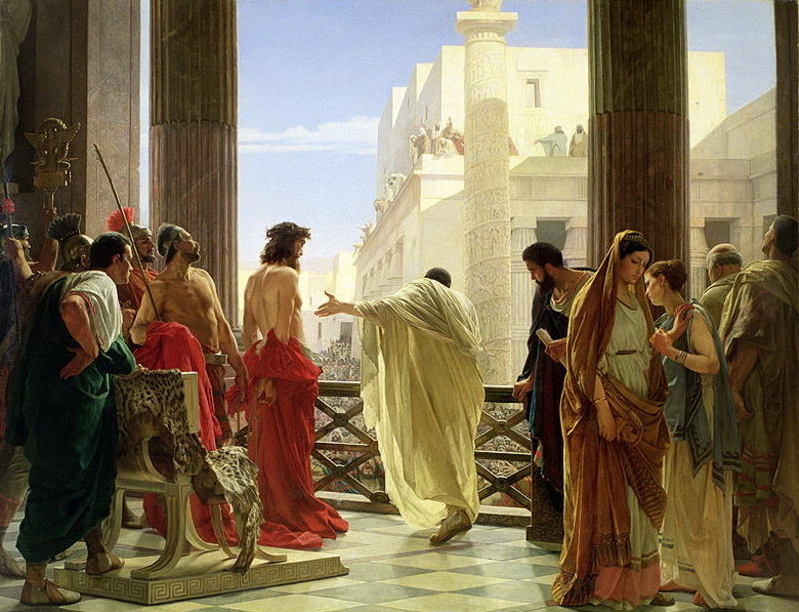
There’s a touching scene during Christ’s Passion, where the Roman governor Pontius Pilate takes Jesus aside – moments before his execution is carried out – and asks him privately, “So you are a king?” Picturing this exchange between the two of them is a rather intriguing image; particularly, the contrast between a Roman Official and a beaten, bloody Jewish Rabbi. The answer Christ gives is provocative, yet has a clarity normally reserved for personal conversations with his disciples:
“You say that I am a king. For this I was born, and for this I came into the world, to testify to the truth. Everyone who belongs to the truth listens to my voice.” (John 18:37)
Pilate must have hesitated for a moment – clearly perplexed, before he responded with “What is truth?”
Our modern era is one where media saturates culture and often dilutes many truths. As a Western culture, we’ve come from a place of accepting a universal truth – whether in science or philosophy – to a place of increased relativism; truth according to the individual. In many cases, one must even squint their eyes to find a sliver of “universal” truth. Press conferences are full of this – as the speaker is just off center enough to fall into the territory of a lie. While we like to reserve this seat for politicians and celebrities – even those who distribute news – modern, Western Christianity is especially prone to this.
As Christians, we’ve all given ear to a preacher as he gives his infallible interpretation on a passage of Scripture with charisma and a dose of passion; and we’ve most likely experienced moments when the interpretation disturbs something inside of us. It could be there is a “word” that challenges us – making us more conformed to Christ; the Holy Scriptures are intended for that. They are profitable for “…teaching, for reproof, for correction, and for training in righteousness.” However, it can also be the case where the words from the pulpit don’t quite sit right with our conscience, and this is problematic. John Henry Newman wrote, “Conscience is the aboriginal Vicar of Christ” – which means that our conscience is in some way connected to the source: the logos that created the world. Without a doubt, we are not aligned perfectly to this source – call it ignorance or original sin – but the reality is we cannot purely listen to our consciences.

Here is where the gift of the Holy Spirit is crucial, as God the Spirit is the inner “voice of Truth” in our hearts, affirming our conscience. Most Christians cling to this and listen for his voice, and in doing so – allow him to be their Shepherd. The Spirit does indeed teach, lead, convict and comfort and fills our hearts so we may receive the full rights of sonship. Nevertheless, some truths – particularly significant truths – are not given infallibly to us as individuals; or to a denomination for that matter. Many evangelicals are content to say: “Well, I have the Spirit in me, and the Bible – the Word of God, therefore I’m right, because the book says it!” (Or, perhaps with a softer demeanor, “God showed me this, therefore it’s true for me, even if it isn’t for you.”) This presents a deeply theological problem: Why would the Shepherd divide his flock? Why would our Father cause confusion among his children? Furthermore, why would the Creator drop Macbeth on our laps without a basic class in Shakespearean literature? How can we possibly interpret ancient, Holy Text? Jesus said that the Holy Spirit would “teach [us] everything” and “remind [us] of all that [he has] said to [us]” and finally, “guide [us] into all the truth” – which has to be true if we take his words seriously – and it is true in the day to day moments of our lives, as he leads us. However, we are living in a time where Christianity has evolved into tens of thousands of denominations, with directly contrasting “truths” – regarding even the fundamentals of Christian teaching (Baptism, Holy Communion, the Nature of Christ, the role of the Holy Spirit, Mariology, etc). Yet we preach that truth is not relative. As a wise man said in Fiddler on the Roof, “He’s right and he’s right, they can’t both be right!”

In addition to this, in recent centuries, we’ve experienced the origins of religious sects of christianity that are at their core not “Christian” – either because they deny Christ as God the Son, or they deny the Holy Spirit, or because they hold to a more polytheistic view of the cosmos. We’ve also seen the rise of New Age philosophy, even versions based loosely on Christian teaching. The fact is, as a Western culture, we love to take Jesus’ words and make them what we want them to say, as we skip over key texts; making him a prophet who affirms our brand of beliefs. This is dangerous. There was a word for this type of spiritualism in the early days of Christianity: Gnosticism.
This brings us back to the experience of a preacher who used his preferred English translation of the Holy Bible to proof text his systematic theology. This is not unique to clergy, as we all take our personal Bibles and do the exact same thing. We take an infallible Holy Text, and we assert our “infallible” interpretation of it (even if we don’t say we do). As the late Rich Mullins (who wrote modern hymns such as “Awesome God”) once said, “Most Protestants have no problem saying ‘The Lord told me this’ and ‘the Lord told me that,’ but they won’t believe that the Lord speaks through the Pope. At least the guy has some credentials.” Ironically, those who protest make themselves the Pope of their personal beliefs. There are many ways in which we do this, but to purposefully avoid hot button topics – as these can be revisited at another time – an intriguing illustration of how truth breaks down is in regard to the so-called “Brothers” of Jesus.

To an outsider of the Church, this may seem petty, but for the sake of Christology and to validate the deposit of faith over the centuries, this is a critical topic for our conversation. Mary, the mother of Christ was declared ‘Ever Virgin’ (aeiparthenos, semper virgo) in the early days of Christianity; and this phrase remained one of her names through the Middle Ages, and into the Protestant confessional writings. Fast forward to the present day, and one would be hard-pressed to find an evangelical Protestant who holds to this view (with notable exceptions to some high church traditions).
“[Mary] remained a virgin in conceiving her Son, a virgin in giving birth to him, a virgin in carrying him, a virgin in nursing him at her breast, always a virgin.” (St. Augustine, Serm. 186, 1: PL 38, 999)
To be fundamentally clear, since the first ecumenical councils – through the Reformation – the Brothers of Jesus were either children of Joseph from a previous marriage, or – they were cousins of Christ, based on the Hebrew expression (the latter being the more favorable view). They were not, however, children of Christ’s Mother, Mary. This may seem heretical to certain Protestants today, but for the sake of our Christian faith we must press this further.
“Christ our Savior was the real and natural fruit of Mary’s virginal womb… This was without the cooperation of a man, and she remained a virgin after that.” (Martin Luther, Sermons on John, chaps. 1-4 (1539): Luther’s Works, vol. 22. p. 23, ed. Jaroslav Pelican, Concordia, 1957)
“The Blessed Virgin Mary, who, as well after as when she brought him forth, continued a pure and unspotted virgin.” (John Wesley, Founder of Methodism {“Letter to a Roman Catholic,” 1749 / In This Rock, Nov. 1990, p.25})
The simplest research will find a plethora of quotations, confirming that all the prominent Fathers’ of the Reformation held to Mother Mary’s perpetual virginity. That’s right – Luther, Calvin, Zwingli, Bullinger – even moving through the centuries to John Wesley. How could these brilliant minds who stood up to the religious establishment hold to this view? How could they – using sola scriptura – hold to a belief that we would argue today is seemingly not found in the Scriptures?
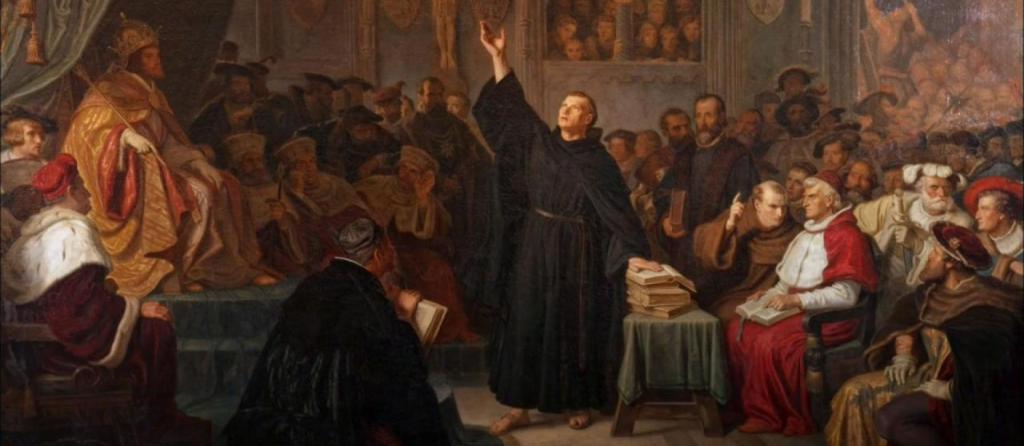
First, it seems reasonable to uphold that the Reformers understood the significance of the deposit of faith; particularly, the definitive writings of the early church fathers in the decades immediately after the Apostolic Age. Second, the Reformers were initially out to correct what they saw as corrupt inconsistencies in the Church, not re-write what was universally established; and they looked to doctors and heroes of the early faith like St. Augustine and St. Ambrose for confirming key doctrines in their confessions:
“Imitate her [Mary], holy mothers, who in her only dearly beloved Son set forth so great an example of material virtue; for neither have you sweeter children [than Jesus], nor did the Virgin seek the consolation of being able to bear another son” (Ambrose of Milan, Letters 63:111 [A.D. 388])
It is a historical fact that our Christian heritage has always affirmed the Brothers of Christ weren’t children of Mary and yet they were his “relatives.” How do we make sense of this?
“Under the word ‘brethren’ the Hebrews include all cousins and other relations, whatever may be the degree of affinity.” (John Calvin, {Pringle, ibid., vol. I, p. 283 / Commentary on John, (7:3)})
If we take a closer look at the Greek word used to translate what we know in English as “brothers” or “brethren,” we may begin to find some clarity. The word is adelphoi, which was used throughout the Septuagint (Greek Old Testament) to translate a broader Hebrew word that meant “family relations.” There was no word in ancient Hebrew for “cousin,” so it was regular practice to use “brethren” in the Old Testament for relationships other than blood brothers. While there are many examples of this, one key example is the relationship between Abraham and Lot – an uncle and a nephew – in Genesis 13:8. In fact, adelphoi is also used primarily to talk about the new Christian family (“brothers & sisters”) in the letters of the New Testament.
“Christ . . . was the only Son of Mary, and the Virgin Mary bore no children besides Him . . . “brothers” really means “cousins” here, for Holy Writ and the Jews always call cousins brothers. (Martin Luther, Sermons on John, chapters 1-4, 1537-39)”
If we apply a simple exegesis to the gospels, there is evidence that affirm the wider use of this word. First, Jesus’s brothers are never called “Children of Mary” – where Jesus himself is. Second, the “other Mary” at the tomb in Matthew’s Gospel is a different Mary than the Mother of Christ (and she’s the mother of James & Joseph). Third, in John’s Gospel, Jesus gives his mother to John the Apostle, which culturally wouldn’t make sense if she had other children to take care of her. Furthermore, our early church historian Eusebius – who we rely on when defending the historical accounts of our faith – gives us some clarity in his account: The Church History. When talking about the Martyrdom of James, Bishop of Jerusalem, Eusebius presents a relationship between some of the “Brothers’ of Christ” as children of Clopas, who is the husband of Mary, wife of Clopas; who is related to Christ’s mother, and is one of at least three Mary’s at the cross in John 19 (as “Marian” was a popular name). Clopas, in turn, is related to Christ’s extended family through Joseph. It’s important to note that Eusebius wasn’t defending Mary’s perpetual virginity, but rather giving an account of the beginnings of the church. He was affirming what many early Church Fathers’ – like Origen – had already given testimony to:
“No one can understand the meaning of [the Gospel of John] unless he has lain on Jesus’ breast and from Jesus has received Mary to be his mother, too. Such a person must he become who is to be another John… For if Mary – as those say who extol her with sound mind – had no other son but Jesus, then He virtually said to Her, “Look! This is Jesus, whom you did bear.” (For He did not say to His mother, “Behold, you have this son also,” but “Woman, behold your son.”) Is it not the case that everyone who is perfect, lives for himself no longer? Does not Christ live in him? And if Christ lives in him, then it is said of him to Mary, “Behold, your son, Christ.” What a mind, then, we must have to enable us to interpret this work [the Gospel of John] in a worthy manner.” (Origen, 228 A.D.)
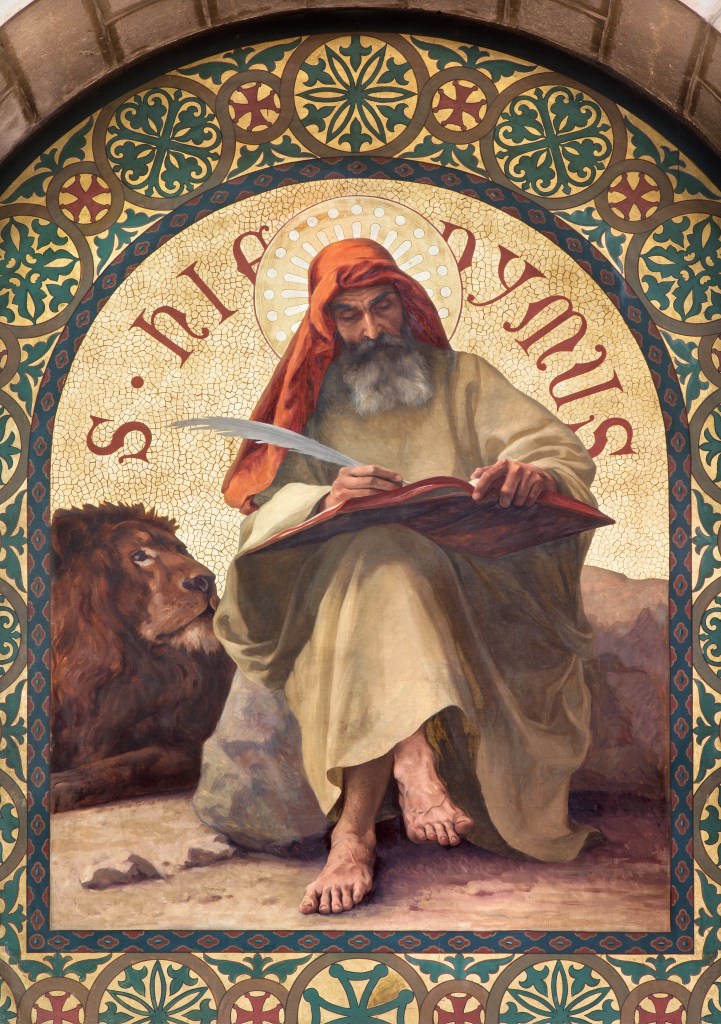
If we continue this thread through our early Christian heritage, we see Mary in the Creeds rightfully called the Virgin Mary – as if it’s essential to her name. If we read the writings of the Church Fathers’– especially those of doctrinal significance, we find this belief held to without reservation. In fact, when the proposition is even made that Mary may have had other children – which was suggested by Helvidius in the late 4th century – the Doctors’ of our faith came against this teaching with the same fervor they did other heresies of that time. St. Jerome (who translated the Greek texts into the Latin Vulgate) opened his letter to Helvidius in unwavering fashion:
“I must call upon the Holy Spirit to express His meaning by my mouth and defend the virginity of the Blessed Mary. I must call upon the Lord Jesus to guard the sacred lodging of the womb in which He abode for ten months from all suspicion of sexual intercourse. And I must also entreat God the Father to show that the mother of His Son, who was a mother before she was a bride, continued a Virgin after her son was born. We have no desire to career over the fields of eloquence, we do not resort to the snares of the logicians or the thickets of Aristotle. We shall adduce the actual words of Scripture. Let him be refuted by the same proofs which he employed against us, so that he may see that it was possible for him to read what is written, and yet to be unable to discern the established conclusion of a sound faith.” (St. Jerome, Against Helvidius)
For Protestants, John Calvin affirmed this standpoint over a millennium later:
“Helvidius displayed excessive ignorance in concluding that Mary must have had many sons, because Christ’s ‘brothers’ are sometimes mentioned.” (John Calvin, {Harmony of Matthew, Mark & Luke, sec. 39 (Geneva, 1562), vol. 2 / From Calvin’s Commentaries, tr. William Pringle, Grand Rapids)
Herein lies the issue: in the present day, we take a word like “brothers” and read it in light of our current understanding; without paying regard to what that word was translated from, or how it was interpreted through course of our Christian lineage. Now we must ask an uncomfortable question: Are there other ways in which we do this? Are there beliefs we hold to that are not fundamentally grounded in Scripture and Christian tradition? To be fair, this is no fault of our own as personal readers, and we can claim a certain amount of ignorance prior to this point. However, what this does prove is that Christians need a deeper understanding of the Holy Scriptures – both regarding the continuity and typology previously established, and even regarding issues with translation. Christians need to be open to pursuing the deposit of faith; the straight line of our heritage, our history. If we don’t pursue these established pillars of our faith, we stay content with the preacher who used their English translation to preach with full authority based on their own understanding; which is ultimately dangerous. We cannot preach something as “Christian truth” unless it is indeed truth.
(As an aside, it may be tempting to say, “why does it matter if Mary did or did not have other children?” The truth is, a solid Mariology always leads to a grounded & glorified Christology. Mary’s very soul “magnifies” Him. The minute we “domesticate” Christ’s Mother, we tamper with the truth of the Incarnation of the Word made Flesh. This is one reason why we have denominations today that do not hold to Christ’s deity, and why our culture – post enlightenment – has looked at Jesus as merely a human prophet. It’s a slow burn.)
If we pursue the truth, we will find it. If we seek, we will find. Jesus promised us this. He is ultimately the Way, the Truth and the Life. He will lead us in paths of righteousness. We must cooperate with him by striving to look past our denominations – our personal beliefs – and into what has been revealed to the Christian Church since the beginning of this revolution, and over the centuries. There is no “gap theory” regarding our history, or else the gates of hell have prevailed. We must break our constant trend of blowing everything up and “starting over;” as if our version of restorationism is the correct one. The Holy Spirit has been guiding the church since the beginning – despite issues of division and corruption. There is truth that is not relative, and this truth is worth the pursuit. If we can open ourselves to what the Church taught for much of its existence, we can perhaps find a unity that has evaded us as Christians in more recent centuries.
“If you believe what you like in the Gospels, and reject what you don’t like, it is not the Gospel you believe, but yourself.” — St. Augustine


 Traditional Faith Blog