
“The blood of the martyrs is the seed of the church.” – Tertullian
As the church moves through the current affairs of the culture, it is wise to turn to the sacred scriptures for comfort. We would do well to turn to the gospels first. However, St. Luke’s “Acts of the Apostles” gives us insight into the first Christians, the birth of the church and the first martyrs. It may be worth starting here. If we want to see how early Christianity navigated its pagan empires and overzealous priests, how it challenged its culture and thrived amid persecution, this is the primary text. Ultimately, if we take in these stories with a spiritual lens, perhaps in contemplation (using Lectio Divina) we will see spiritual truths that we desperately need in our reality today. With this in mind, we turn our focus to St. Stephen, the first martyr.
Stephen, full of grace and power, did great wonders and signs among the people. Then some … stood up and argued with Stephen… they could not withstand the wisdom and the Spirit with which he spoke… they secretly instigated some men to say, “We have heard him speak blasphemous words against Moses and God.” They stirred up the people as well as the elders and the scribes; [they] seized him, and brought him before the council. They set up false witnesses who said, “This man never stops saying things against this holy place and the law”… and all who sat in the council looked intently at him, and they saw that his face was like the face of an angel… (Acts 6:8-15)
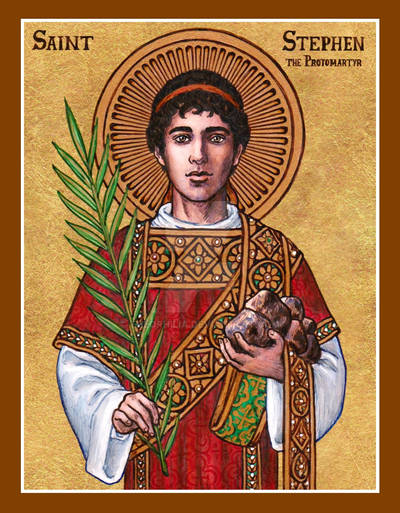
by
Theophilia
Those who know this story, know that Stephen is a new convert to Christianity. He is filled with the Holy Spirit; and he is teaching, performing miracles and turning hearts to Jesus alongside the apostles. He is challenging the current regime, the status quo and proclaiming the resurrection of Christ. To say this message is offensive to the religious leaders (and the political leaders) of his day is an understatement. He is brought before the Council in Jerusalem under false pretenses by those who wish to harm him, and he’s accused of blasphemy. As we shall see, the parallels between his stoning and Christ’s crucifixion are poetically striking. At this point in Stephen’s story we are reminded how Christ was brought before the Council at the beginning of his Passion in the gospel accounts.
And they led Jesus to the high priest. And all the chief priests and the elders and the scribes came together…. many bore false witness against him… some stood up and bore false witness against him, saying, “We heard him say, ‘I will destroy this temple that is made with hands…’ ” …But he remained silent and made no answer. (Mark 14:53-61)
While Christ’s silence to his accusers is profound, our Lord eventually gives a definitive answer (“…you will see the Son of Man seated at the right hand of Power, and coming with the clouds of heaven”). In a similar way, Stephen responds to the Council with boldness, wisdom and clarity. In fact, his speech in Acts 7 is one of the great texts in the “Acts of the Apostles.” Just like Peter’s inaugural address after Pentecost (and his speech in Solomon’s Portico); and Paul’s address in Athens at the Areopagus, Stephen’s testimony moves through salvation history; the patriarchs, the prophets, and the history of the nation – culminating in who Christ is as the Anointed One. It is because of this he is stoned to death.
“You stiff-necked people, uncircumcised in heart and ears, you are forever opposing the Holy Spirit, just as your ancestors used to do. Which of the prophets did your ancestors not persecute? They killed those who foretold the coming of the Righteous One, and now you have become his betrayers and murderers. You are the ones that received the law as ordained by angels, and yet you have not kept it.” (Acts 7:51-53)

In the story of the stoning of St. Stephen, we see the beautiful paradox of Christianity at its fullest. We see the theological virtues; faith, hope and love. We see the virtue of fortitude on full display, as many do in courtrooms; when an unjustly condemned person stands for truth, against his oppressors, against darkness, against the majority, and calls out their evil (“You.. received the law as ordained by angels… you have not kept it”). However, there is a stark contrast to our modern courtrooms. After Stephen’s testimony, when his accusers decide to murder him on the spot, and while he is in fact being killed – we see a type of peace, a specific grace, and a surrendering faith: “Lord Jesus, receive my spirit,” Stephen exclaims. One can picture him stumbling to stand; in his humanity fighting for his life, but in his spirit submitting to the blows of the stones. Stephen’s self-abandonment mirrors Christ Jesus when he gave up his spirit on the cross.
Then Jesus, crying with a loud voice, said, “Father, into your hands I commend my spirit.” Having said this, he breathed his last. (Luke 23:46)
It is worth reading the account of St. Stephen’s stoning in full.
When they heard these things, they became enraged and ground their teeth at Stephen. But filled with the Holy Spirit, he gazed into heaven and saw the glory of God and Jesus standing at the right hand of God. “Look,” he said, “I see the heavens opened and the Son of Man standing at the right hand of God!” But they covered their ears, and with a loud shout all rushed together against him. Then they dragged him out of the city and began to stone him; and the witnesses laid their coats at the feet of a young man named Saul. While they were stoning Stephen, he prayed, “Lord Jesus, receive my spirit.” Then he knelt down and cried out in a loud voice, “Lord, do not hold this sin against them.” When he had said this, he died. (Acts 7:54-60)
How curious it is that Stephen is given a glimpse of heaven moments before his death, and that he uses this grace to try and get the attention of his opponents, almost as if to warn them. He is communicating grace until his last breath. Then, Stephen flips the script by advocating on behalf of his murderers (“Lord do not hold this sin against them”). This is the final blow to their stones; one last appeal for mercy to be extended to his killers. Stephen echoes Christ’s final words on the cross, using his last breath as a sort of mediation for his opponents. The rationale is that they are acting in ignorance; they believe what they are doing is right and just. This sin, as Stephen cries out, shouldn’t be held against them.
Then Jesus said, “Father, forgive them; for they do not know what they are doing.” (Luke 23:34)

Here we see the Lord’s Prayer in real time. Here we learn what it means to pray “forgive us our trespasses, as we forgive those who trespass against us.” This is self-emptying love. This is how to “pray for those who persecute you.” It is no sin to fight for truth and holiness, on the contrary, it is noble and right. It is no sin to stand against corruption, nor to challenge your accusers. The sin lies in one’s disposition of heart towards the soul of their opponent. The sin is to fail to see them as Imago Dei (the “image of God”). To follow Stephen’s example is to participate in this “greater love” for mankind – a love that “will[s] the good” of the other, as Thomas Aquinas wrote. We all have dignity.
“Every man, every woman, every believer: we are all a gift from the Lord, a very precious gift. Each of us is a gift for everyone and for the whole Church, taking flesh in a context, in a time, in a specific place.” – Pope Francis
What would it look like if Christians exemplified this level of boldness, grace, and self-giving love? How could this world change for the better if Christians didn’t cower, but were rather filled with the strength to proclaim Christ crucified (Kýrios Iēsoûs, “Jesus is Lord”), and advance the kingdom of God; a kingdom of justice, mercy and love. Greater still, is it possible to do this in a way that isn’t obnoxious and mean-spirited, but rather graceful, without bitterness for our neighbour? There are devils in this world, to be sure, and even children of the devil, but that reality doesn’t negate the purely Christian call to love our enemies. In fact, this love may indeed call out what is plainly evil, for their own good; but graciously and boldly. Finally, when it is our turn to be martyred, as we must anticipate – can we not only forgive those around us, but also mediate on their behalf to our Father in Heaven? Can our blood be a means of grace for our accusers? May our love be this great.
To finish where we began, we turn to the second century, a time of severe christian persecution, to an early church father named Tertullian, who wrote a document titled Apologeticus, which he addressed to the provincial governors of the Roman Empire:
“We are not a new philosophy but a divine revelation. That’s why you can’t just exterminate us; the more you kill the more we are. The blood of the martyrs is the seed of the church. You praise those who endured pain and death – so long as they aren’t Christians! Your cruelties merely prove our innocence of the crimes you charge against us…” (Apologeticus, 197 AD)
May we see the heavens open, and the Son of Man descend with his angels.
in nomine Patris et Filii et Spiritus Sancti

 Traditional Faith Blog